I chose the name because it sounds like my own. Only later did I look at the animal properly, and it turned out to describe the work better than I had.
October 2026
As ecosystem engineers, alligator trails and holes provide refuge for wading birds and fish during the dry season.
U.S. Geological Survey, 2004
My family name is Allegaert. Say it quickly and the alligator is already half there, so when I needed a name for a small web practice the choice took about a minute. It was a matter of sound, not of meaning: the two words alliterate, and the echo runs on past the first letter.
A mascot came with it, and a mascot invites the question every visitor is entitled to ask: why that animal? I did not have a good answer. So I went and read about alligators, the way I would read up on any subject before writing about it. Here is what we know about the alligator.
A lizard with its article attached
The word is a corruption of the Spanish el lagarto, “the lizard”, in full el lagarto de Indias, the lizard of the Indies. English heard the article and the noun as one word. It turns up as lagarto and aligarto in the 1560s, and in its modern spelling from the 1620s. Behind the Spanish is the Latin lacertus, lizard.
For someone who started out writing manuals, that is a pleasing origin. The name of the animal is a small misreading that was used often enough to become correct. Most of the vocabulary of the web came about the same way.
A shape that did not need changing
Crocodilians today look much like their relatives of some two hundred million years ago. A study from the University of Bristol in 2021 put that down to a pattern of long stability with occasional bursts of change: the body plan was efficient and versatile enough that there was little pressure to alter it.
The same researchers add a caution that belongs here too. The group was once far more varied, with giants, plant-eaters, runners and sea-going forms, and most of them are gone. What survived is not the oldest design but the one that kept working. That is the argument behind a good part of these notes, about paragraphs, links and type: a form that was right early does not have to be reinvented every season, and the ones that were merely fashionable do not last.
Doing a lot on very little
An alligator cannot regulate its own body temperature. It takes its warmth from the sun and the water, and as a result it needs far less food than an animal that burns energy to stay warm. The Bristol researchers think that may be part of why crocodilians came through the extinction that ended the dinosaurs.
I work a few focused hours a day and spend the rest outside. I used to think of that as a limitation to apologise for. An animal that has outlasted almost everything by spending little and moving when it matters suggests another way of putting it.
The water hole
This is the part I did not know, and the one I keep coming back to. In the Everglades, alligators dig holes into the muck and peat, often down to the limestone underneath. When the dry season comes and the marsh shrinks, those holes keep their water. Fish survive in them and later restock the marsh. Wading birds, turtles and snakes come to feed, other reptiles nest at the edges, and plants take root around them. The U.S. Geological Survey calls the alligator an ecosystem engineer; the National Park Service has long regarded it as a keystone species of the Everglades, largely because of these holes.
The alligator does not dig them for the birds. It digs them for itself, and the rest of the marsh lives off the fact that it does the work well. That is close to what I would like a small website to be: something built properly for one owner, sturdy enough to come through the dry season, with room for whoever turns up.
Strong and careful at once
In 2012 a team led by Gregory Erickson measured the bite of a wild American alligator four metres long at close to 3,000 pounds of force, about 13,000 newtons. In the same year Duncan Leitch and Kenneth Catania looked at the small dark spots that cover the jaws of alligators and crocodiles. They are touch receptors, and some respond to pressure too faint for a human fingertip to detect.
Leitch and Catania point out what that sensitivity is for. The jaws with that bite are also the ones a female uses to break open her eggs without harming what is inside, and to carry her hatchlings. Force is easy to come by. Knowing exactly how much to use is what takes a lifetime, in animals and in trades.
Written off and back
The American alligator was listed as endangered in 1967, under the law that preceded the Endangered Species Act. Twenty years later, in 1987, the U.S. Fish and Wildlife Service declared it recovered. It came off the list because it had come back, not because it was gone.
What the drawing has to do
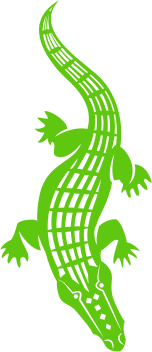
Most people meet the alligator first as a predator: thick skin, a snap of the jaws. That is not the tone I want, so the mascot avoids it. It is seen from above, in mid-stride, with its mouth closed, moving down the page rather than towards you. The snout is broad and rounded, because that is how you tell an alligator from a crocodile, and a crocodile on a shirt already belongs to someone else.
On the page it is decoration and gets an empty alt text, so a screen reader skips it. Everything it stands for is in this note, in words, where anyone can read it.
Read the originals
- U.S. Geological Survey, American Alligator Ecology and Monitoring for the Comprehensive Everglades Restoration Plan (Fact Sheet 2004-3105). Two pages on the holes, the trails and who lives off them; the source of the quote above.
- Online Etymology Dictionary, alligator. From el lagarto de Indias to the modern spelling, with the dates.
- Duncan B. Leitch and Kenneth C. Catania, Structure, innervation and response properties of integumentary sensory organs in crocodilians (Journal of Experimental Biology, 2012), as reported by ScienceDaily. Why the most dangerous jaws are also the most delicate.
- Gregory M. Erickson et al., Insights into the Ecology and Evolutionary Success of Crocodilians Revealed through Bite-Force and Tooth-Pressure Experimentation (PLoS ONE, 2012), as reported by ScienceDaily. The bite, measured in the field.
- University of Bristol, Research explains why crocodiles have changed so little since the age of the dinosaurs (2021), on Stockdale and Benton in Communications Biology. The long stability, and the caution about everything that did not survive.
- National Park Service, Everglades, CESI Research Project 01-8. A study of alligator holes, and the plainest statement of the alligator as a keystone species.
- Texas Parks and Wildlife, History of the American alligator. The listing in 1967 and the recovery in 1987, in a few paragraphs.