For a few years, every photographer had a home on the web. Our photoblog was called eMotionBlog, and it was a family album with an address.
October 2026
From August 2003 until 2005 we posted to eMotionBlog.com, by the end every day. It was a family thing: my wife, our three children and me, living in Brussels back then. The about page called us “enthusiastic photographers, keen to learn more about all aspects of digital photography”, and the blog “our secret little spot on the web”, which is a lovely thing to write on a public website. The line under the name started as “Picture communication from the hip, snapshots mainly…” and became “Daily dose of hipshots”: pictures taken from the hip, without bringing the camera to the eye, so that nobody stiffens up for the lens. Mostly people. Friends, a small girl smiling at the camera, somebody playing a melodica, a night of bowling, and now and then somebody famous who happened to cross my path: the queen, a singer from the new wave years.
The archive was sorted not only by month but by person. Every picture carried the first name of whoever was in it, and the sidebar listed them with a count: some names once, some twenty times, “Anonymous” for strangers and “No people” for the rare picture without anyone in it. That list is the best description of what the blog was. The names that came back most often were our own, the five of us. It was a record of a family and the people around it. The address has belonged to somebody else for a long time now. The Internet Archive kept a copy from November 2004, and reading it again is what made me write this.
A photoblog was a simple idea: pictures on your own site, newest at the top, a small box underneath for comments. Most photobloggers posted one picture a day. A post on eMotionBlog was a short series of the same moment, two, three, sometimes five frames: a family photo in a key ring, then the same key ring with the keys around it, so you could see where it hung. Hipshots miss as often as they hit, and the repetition was half the pleasure. No captions to speak of, no feed of everybody else’s pictures. You visited a photographer the way you would visit a friend: on purpose, at their address.
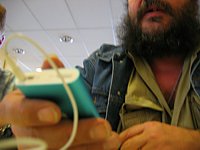
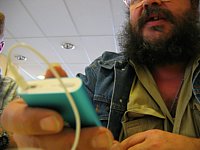
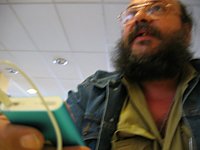
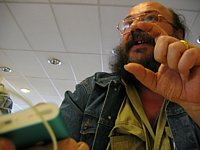
That is one post as it was. A man I knew a little, from Antwerp, is looking at his music player. He notices the camera at my hip, looks up, and ten seconds later he has a finger in the air and a story going. The frames are 200 pixels wide, because that was the rule, and they are in the order the camera took them.
The about page also set out the house rules, and they say a lot about the web of 2004. Every picture was shown “as truthfully as possible, without much manipulation”. None was wider or taller than 400 pixels, none heavier than 40 kilobytes, and most stayed under 15. Plenty of visitors were still on slow connections, and a photoblog that took a minute to load was a photoblog nobody came back to. And the whole blog carried a Creative Commons licence: anyone could reuse a picture, as long as our name went with it, nobody made money from it and the result was shared on the same terms. The licences themselves were barely two years old.
The camera came first
What made it possible was a price. In January 2004 Nikon announced the D70, a real single-lens reflex for 999 dollars without a lens. Canon’s 300D had broken the same barrier a few months before. Five years earlier Nikon’s first professional digital SLR, the D1, had cost twice as much as its best film camera. Now a serious camera was something an amateur could save for, and a lot of us did.
I had the D70, then the D70s, and later the D300. In front of them went a Tokina 12–24 f/4, a wide-angle I still put on a Nikon now and then, and a Sigma 30 mm f/1.4 for indoors, where there is never enough light. But the first lens I bought, and the one I loved most, was a Nikon 85 mm f/1.8: a portrait lens with beautiful light and a background that melts away behind whoever you point it at.
Most of eMotionBlog, though, was not made with those. The about page names our favourite of 2004: a Canon PowerShot A80, “a lot of settings for such a small camera”, and above all a screen that folded out. The best small cameras had one. You could hold the camera at your waist and look down into it, or lift it over a crowd, or put it on the ground. It was the old Rolleiflex all over again: a camera you look into rather than through, which changes where you stand and how people react to you.
And film on the side
The digital cameras were precise, so of course we went looking for the opposite. Fisheye lenses. Old film cameras from the East, through Lomography: a movement started in Vienna in 1992 by students who had found a Russian Lomo LC-A in a camera shop in Prague. The cameras were cheap and imperfect, colours ran, corners went dark, and that was the point. Its rules told you to shoot from the hip, upside down, wherever the moment took you, which is exactly what eMotionBlog did with a digital camera. Lomography is still going. And the Holga, a plastic camera first sold in Hong Kong in 1982, which takes medium-format film through a lens that blurs the edges and lets light in where it should not. People loved it for exactly those faults.
I still have most of them, and most of them still work. That is worth saying about a period that is now mostly remembered through the services it ran on: the cameras outlived the websites.
The blog also led somewhere. Friends who had seen it asked me to photograph their weddings and their children’s first communions, and I put those online as reportages. Now and then a company paid me for a photo assignment. None of it was a career; all of it came from posting pictures where people could find them. And it is where I became a photographer. The first wave of affordable digital cameras made every frame free, the blog asked for new pictures every day, and the comments told me which ones worked. Nobody teaches you faster than that.
A web of people looking at each other’s pictures
Running a photoblog meant running a website. Mine ran on Movable Type 3.12; you rented space, installed the software, chose a template and usually rewrote it. What held the scattered sites together was what held the whole early web together: links. Every photoblog had a list of other photoblogs down the side, and many belonged to a webring, a chain of sites with three links at the bottom of each one. Mine said Join, Random and List, and Random was the best of the three: one click and you were on a stranger’s doorstep in another country. Photoblogs.org was the directory everybody checked. From 2005 there were even awards, the Photobloggies, sorted by region and by subject.
It was a small world and a generous one. The comments under my pictures came in Dutch, French and English, sometimes all three under one photograph, which is about as Brussels as a website can get. Under the queen somebody wrote “Vive la république!”; under a picture of friends somebody wanted to know whether a hand gesture meant devil worship or Metallica. People linked to each other’s work without being asked and came back the next day to see what you had made. Nobody counted followers, because there were none to count.
Then Flickr
Flickr went online in February 2004, made in Vancouver by a small company that had built it out of the tools for an online game. It was not the first place to share photographs, but it was the first that felt like it had been made by people who took them. Tags, groups around a subject or a city, comments, a licence you could set so others could reuse your work, and an open door for programmers who wanted to build on it. For a photographer it was a photoblog without the server.
Yahoo bought it a year later. In 2007 it was still among the twenty most visited sites in the world. Then the founders left, the layoffs came, and in 2010 Instagram arrived on a phone that was by then good enough. Flickr was not beaten so much as left to drift. In 2018 it was sold again, and in 2019 free accounts went from a terabyte of space to a thousand photographs.
What went with it
It is tempting to say that what disappeared was real cameras. It was not. A phone takes a better picture today than my Nikon D70 did, and plenty of people who make serious work use one. What disappeared was the place. A photoblog was yours: your address, your order, your pace, your list of people worth visiting. A feed is somebody else’s order, and it decides who sees what.
We stopped in 2005, and after a while I let the domain go. Somebody else registered it, a wedding photographer, without asking and without doing much with it. Nothing wrong with that, but it is the plainest lesson of the whole period: the pictures you keep are the ones on your own disk, and the address you keep is the one you keep paying for. The same thing happened to writing, which is the subject of When we stopped writing on our own sites.
Years later I bought a Fujifilm X100, a small camera with a fixed lens and a viewfinder you look through like a rangefinder. Reviewers compared it to a Leica costing many times as much. It has the most beautiful light of any camera I have owned. I take it outside, and the pictures stay on my own disk. For the moment.
Read the originals
- eMotionBlog, as the Internet Archive saved it on 16 November 2004. What this note is about, as it was.
- Wikipedia, Flickr. The dates, from the launch in 2004 to the thousand-photo limit in 2019.
- Digital Photography Review, Nikon D70 Review (2004). The camera, its price and the Canon it was answering.
- Nikon, The D1 camera. How the digital SLR became a professional tool, and what it cost.
- Blogger, 2005 Photobloggies (2005). The awards, and how the community sorted itself.
- Wikipedia, Creative Commons license. The first licences, from December 2002, and what each condition means.
- Lomography, Our story. The movement in its own words, from a camera shop in Prague to today.
- Wikipedia, Holga. A plastic camera from Hong Kong, and why its faults were the point.